Through-feed T 2020 / T 2030
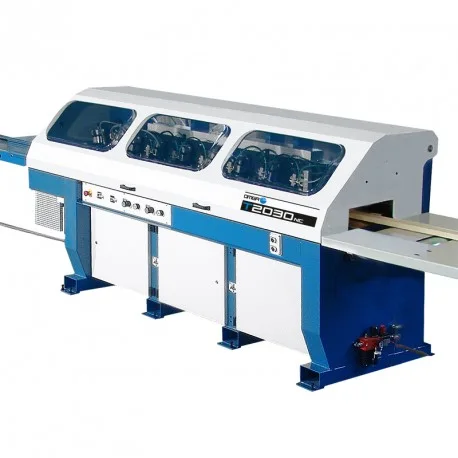
Drive rollers guide the board through the system. For intensive cutting with reading of marks and selected sorting options.
More details ↗
OMGA / CROSS-CUTTERS AND WOOD CUTTING OPTIMISATION
When cross-cutting timber, the program and equipment determine the cutting sequence and execution. Compare OMGA through-feed and push-feed systems according to material, defect marking and volume.
Explore the options ↓ Official page ↗
WORKING METHOD IS THE FIRST DECISION
Drive rollers guide the board through the system. For intensive cutting with reading of marks and selected sorting options.
More details ↗The push unit guides the board. OPT versions combine length cutting and optimisation cycles depending on the model.
More details ↗Prepared lengths and repeated cuts. SNC does not automatically mean the same defect optimisation as the OPT version.
More details ↗Pneumatic cutting cycle; with a properly connected FP, also programmed positioning.
More details ↗HOW ARE DATA AND CUTS LINKED?
Define the required lengths, quantities and quality. Mark defects or quality grades in a way the chosen system can read.
A person defines the requirements and prepares the material.The program takes into account the input board, the list of pieces and the received marks. It calculates the cutting plan according to the selected cycle and takes removal parts into account.
The program calculates; the equipment and cycles depend on the version.The feed system positions the board, the saw makes the cuts. Separation of pieces and waste depends on the output equipment. Reports help track the result.
The machine performs the prepared sequence; the operator supervises the work.ROLL FEED
Several drive rollers and upper pressure elements help guide boards with the usual variations of raw material. T 2030 has a longer feed unit with 11 drive rollers; T 2020 has 7. Preparation of the cutting list, reading marks and output organisation are linked parts of the system.
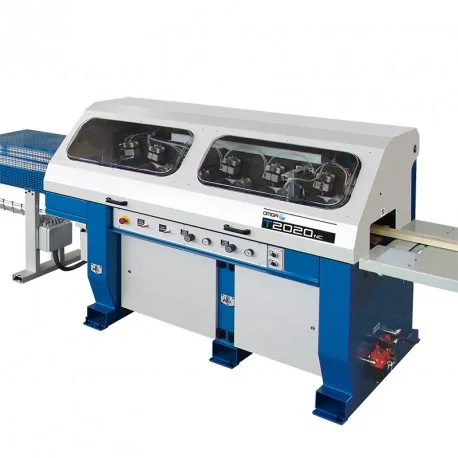
A more compact through-feed version. The choice depends on the input lengths, board guidance and the required output equipment.
| Drive rollers | 7 |
|---|---|
| Minimum input length | 600 mm |
| Saw motor | 5.5 kW; 7.5 kW option |
Technical source: OMGA · T 2020 NC ↗
Extended roller path for intensive work and organised output of pieces. The maximum feed speed is a system specification, not a promise of the number of good pieces.
| Drive rollers | 11 |
|---|---|
| Maximum feed speed | 240 m/min |
| Minimum input length | 600 mm |
Technical source: OMGA · T 2030 NC ↗
| Blade Ø 450 mm | 220 × 90 mm or 270 × 50 mm |
|---|---|
| Optional blade Ø 500 mm | 220 × 120 mm or 300 × 50 mm |
| Width above 220 mm | The sorting configuration must be agreed separately |
The limiting widths and heights are not one combined capacity. For the T 2020, the web table states 240 m/min, while the enclosed older brochure states 180 m/min; the speed and control generation will be confirmed for the offered version.
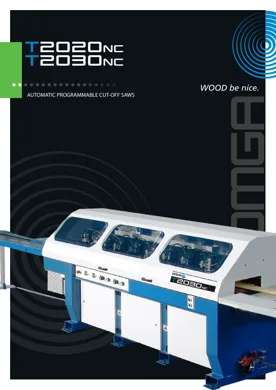
Roller feeding, cycles, cutting diagrams and equipment options. The brochure also shows an older generation of control.
Official PDF · 3 pages · 2.1 MBOPTIMA / PUSH CUTTING
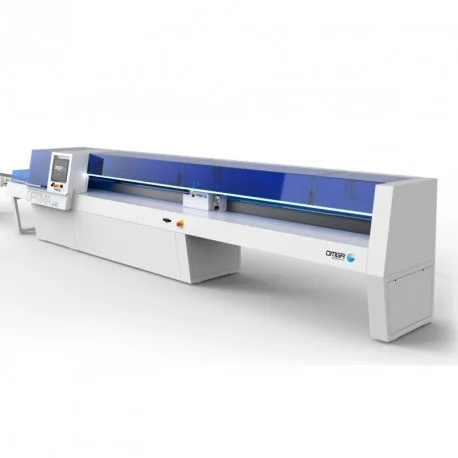
The most powerful push-feed version in this range. Rear board grip, linear measuring and the preparation table combine stable guidance with preparation of the next pieces. The 19-inch display makes the job easier to follow.
| Maximum feed speed | 240 m/min |
|---|---|
| Saw motor | 5.5 kW; 7.5 kW optional |
| Input lengths by version | up to 4200 or 6200 mm |
Technical source: OMGA · OPTIMA 240 ↗
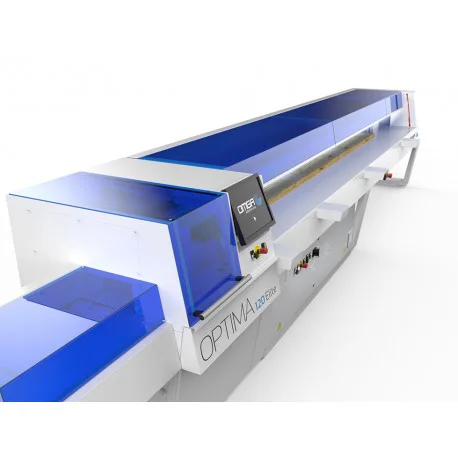
Preparation table and board grip for organised work. A suitable comparison when you need more advanced handling, but not the highest speed of the 240 model.
| Maximum feed speed | 120 m/min |
|---|---|
| Saw motor | 4.6 kW |
| Input lengths by version | up to 4200 or 6200 mm |
Technical source: OMGA · OPTIMA 120 Elite ↗
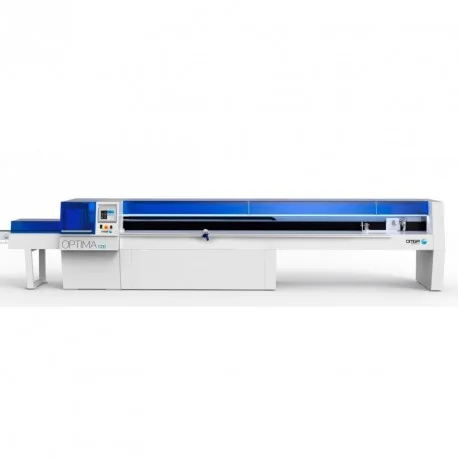
Push-feed optimisation with board guidance and a 10.4-inch display. Data transfer and reports via USB or Ethernet are part of a connected workflow.
| Maximum feed speed | 120 m/min |
|---|---|
| Saw motor | 4.6 kW |
| Input lengths by version | up to 4200 or 6200 mm |
Technical source: OMGA · OPTIMA 120 ↗
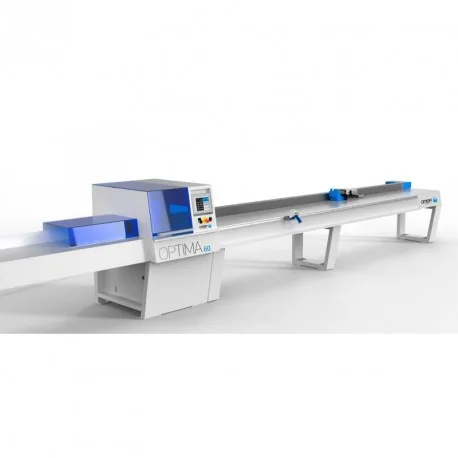
A starting point for less intensive cutting. The lower feed speed provides a different price and organisation basis; rear board grip is an additional option.
| Maximum feed speed | 60 m/min |
|---|---|
| Saw motor | 4.6 kW |
| Input lengths by version | up to 4200 or 6200 mm |
Technical source: OMGA · OPTIMA 60 ↗
| OPTIMA 240 · width × height | 215 × 100 / 244 × 80 / 275 × 50 / 300 × 18 mm |
|---|---|
| OPTIMA 120 Elite, 120 and 60 | 200 × 110 / 245 × 80 / 275 × 50 / 300 × 14 mm |
The board cross-section, blade shape and specific version determine the cutting range. The dedicated KC version of the 240 model has different limits; data from different versions must not be combined. Larger blade, automatic loading, sorting, printing and additional measurement are specified separately.
Official OMGA footage. The additional equipment shown is not necessarily included in the base model.
Open on YouTube ↗Official OMGA footage. The additional equipment shown is not necessarily included in the base model.
Open on YouTube ↗Official OMGA footage. The additional equipment shown is not necessarily included in the base model.
Open on YouTube ↗Official OMGA footage. The additional equipment shown is not necessarily included in the base model.
Open on YouTube ↗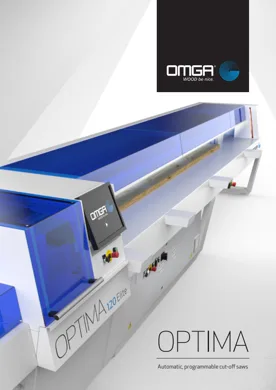
Comparison of OPT and SNC, cutting diagrams, program cycles and accessories.
Official PDF · 9 pages · 7.6 MBPROGRAMMING PREPARATION
Instead of repeatedly setting each cut, prepare a job. Data transfer, storage and reports depend on the selected control system.
The optimisation system reads suitably prepared marks or data from the agreed equipment. This does not mean that the base machine can visually recognise all wood defects on its own.
Cycles can include quality classes, different priorities and rejection of remnants. The OPTIMA 240 and Elite have a wider range of cycles than the base versions; SNC has a different scope.
Reports help track produced quantities and material consumption. Scanner, additional label reading, printer and sorting stations are separate configuration choices.
Yield depends on the quality and dimensions of the input boards, the required lengths, cutting width and selected priorities. We do not determine the savings percentage without your actual production sample.
PROGRAMMED CROSS-CUTTING
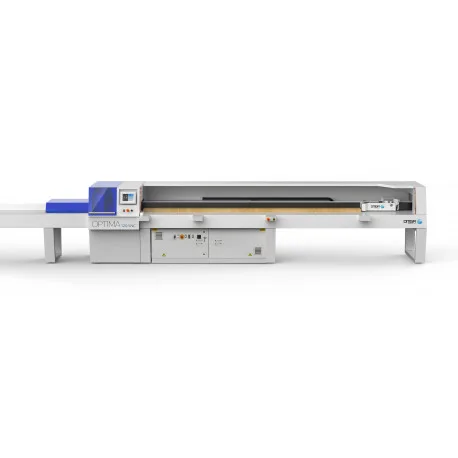
For a programmed sequence of cuts with a maximum feed of 120 m/min. The advantage is repetitive tasks; the cycles of this version are not the same as OPT optimisation.
Technical source: OMGA · OPTIMA 120 SNC ↗
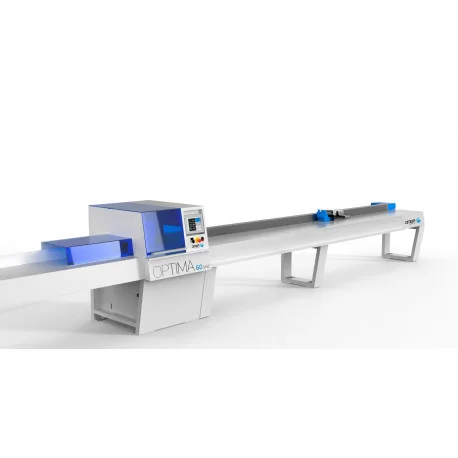
Version with up to 60 m/min for a different work intensity. Bundle cutting and special materials require suitable equipment and confirmation of the working area.
Technical source: OMGA · OPTIMA 60 SNC ↗
Manufacturer's presentation of the dedicated aluminium version. The ALU features do not automatically apply to the wood version.
Open on YouTube ↗SAWING MACHINE WITH BLADE LIFT
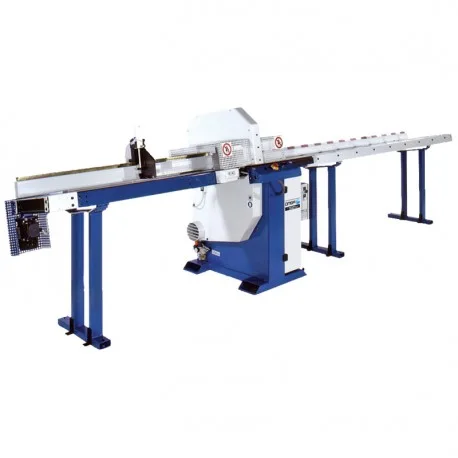
Pneumatically guided saw blade lift with adjustable stroke and clamping. Complete the basic cutting machine with suitable tables and fences.
| Saw blade | Ø 450 mm; Ø 500 mm option |
|---|---|
| Motor / speed | 4.6 kW / 3000 min⁻¹ |
| Extraction connection | Ø 160 mm |
Technical source: OMGA · T 521 ST ↗
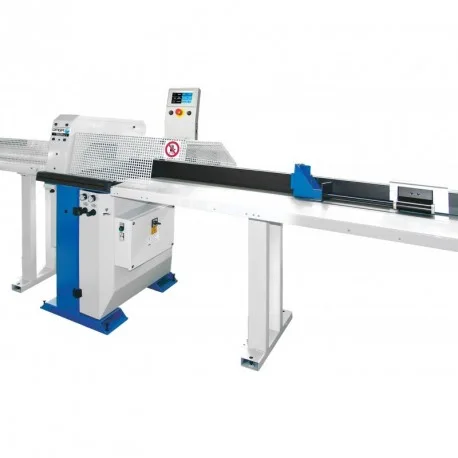
Connected version for NC positioning and cut-to-list production. When selecting, we verify the input path, fence or pusher, clamping and safety interlock.
Technical source: OMGA · T 521 SNC ↗
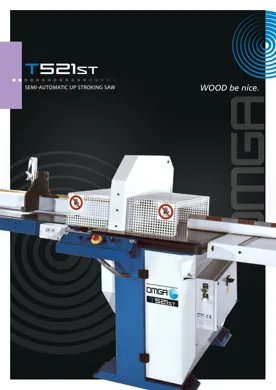
Basic design, cutting diagrams and technical data.
Official PDF · 2 pages · 0.9 MBBEFORE YOU CHOOSE
Basic reading of markings is not the same as automatic surface inspection. We check the marking method, the required quality grades and any connection to a dedicated scanner.
No. Lengths, acceleration, cross-section, cutting cycle, loading, material quality and sorting all affect it. Capacity is assessed on your own set of parts.
The systems shown cut and prepare the parts. Joint preparation, glue, assembly and pressing are subsequent operations on other equipment.
EQUIPMENT SELECTION
Specify the material, cross-section, input and final lengths, angles and approximate quantity. Add a description of the current working method. This allows us to determine the right saw, clamping, feed and software options.
Send enquiry ↗The form keeps the source page. The version, accessories and price are determined in an individual offer.