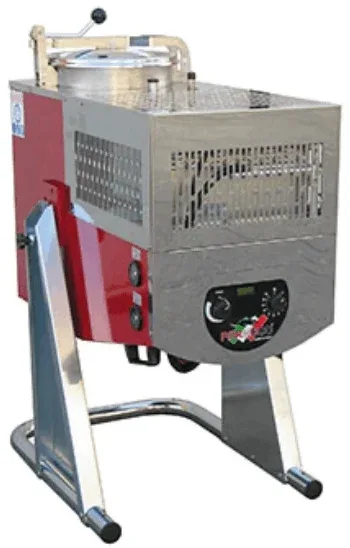
DISTATIC
Di · static version
For liquids for which processing without a scraper is suitable. Depending on the residue, a Rec-Bag is used or the kettle is emptied by tilting.

FORMECO / SOLVENT DISTILLERS AND EVAPORATORS
FORMECO distillers for solvent regeneration and evaporators for water-based process fluids and emulsions. The technology is selected according to the fluid composition and the target of separation or reuse.
 Official page ↗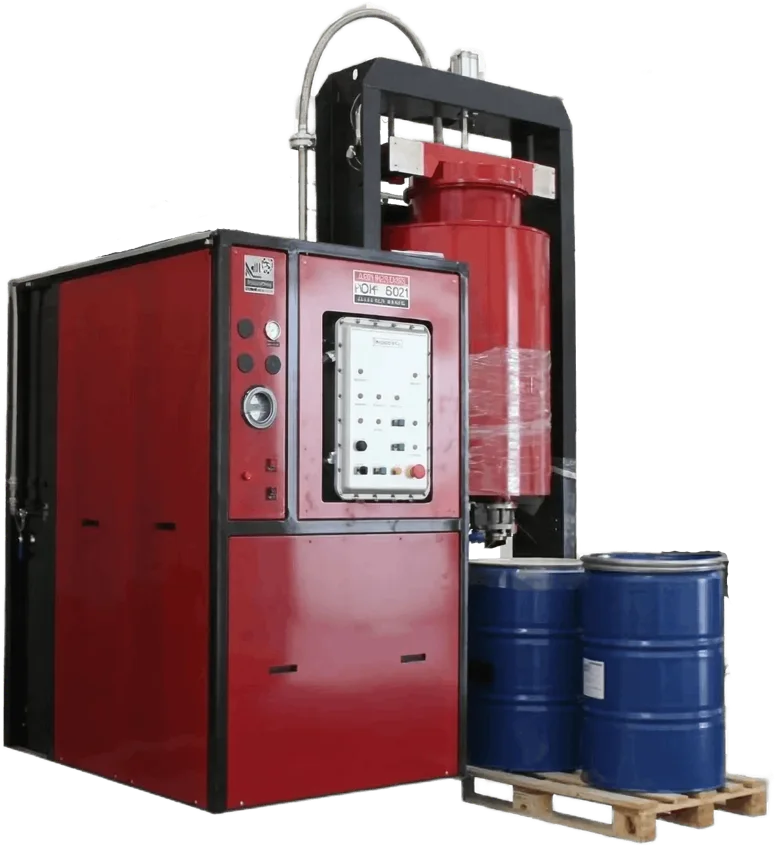
SPECIALIST IN LIQUID SEPARATION
The Italian manufacturer develops and produces solvent distillers, process water evaporators and fractional distillation systems. Its solutions are used in surface treatment, paint and printing ink production, metalworking and other industrial processes.
Equipment selection is supported by its own laboratory and pilot units. This allows the actual fluid to be tested before deciding on the size and version of the plant.
About the manufacturer and technology development ↗UNDERSTAND THE PROCESS
The solvent or water evaporates and then condenses. Less volatile components remain in the concentrated residue. The equipment and process settings are adapted to the incoming fluid.
Contaminated solvent or water-based process fluid.
Solvent or water becomes vapour; less volatile components remain.
The vapour cools and becomes liquid again.
The condensed liquid is collected separately.
Less volatile components are discharged separately from the distillate.
For example, used oil emulsion or wash water from production.
At reduced pressure, water evaporates at a lower temperature. The resulting vapour is cooled and condensed.
The aqueous fraction is collected as distillate; oils and other less volatile components concentrate in the residue.
Simplified illustration of the principle. The quality of the distillate, the proportion of liquid removed and the handling of the concentrate are checked for the specific mixture.
01 / SOLVENT REGENERATION
Distillation separates suitable solvents from resins, pigments, paints, oils and other less volatile residues. The solvent is heated via a jacket with thermal oil, and the resulting vapour is condensed by air or water cooling.
DISTATIC
For liquids for which processing without a scraper is suitable. Depending on the residue, a Rec-Bag is used or the kettle is emptied by tilting.
DYNAMIC
An internal scraper moves the contents and reduces residue sticking to the walls. The version is selected according to the behaviour of the liquid during concentration.
| Data | Di 30 Ax LCD | DiQ 60 Ax LCD |
|---|---|---|
| Useful fill | 30 l | 60 l |
| Total kettle volume | 43 l | 103 l |
| Internal scraper | No · static version | Yes · dynamic version |
| Connected load | 2.04 kW | 4.2 kW |
| Electrical connection | 230 V / 50 Hz, single-phase | 400 V / 50 Hz, three-phase |
| Condenser cooling | Air | Air |
The data apply to the stated Ax LCD versions from the catalogues. Useful fill is not the total kettle volume; connected load is not the energy consumption per cycle.
The Professional series enables multi-stage process control and, depending on the equipment, sequential batches, automatic filling or emptying. Industrial is intended for larger quantities and for integrating regeneration into production.
The DQ 250 example has a useful fill of 250 l. The DQ 250 Wx catalogue lists water cooling of the condenser, a connected load of 16 kW and a three-phase 400 V / 50 Hz connection. Versions and additional equipment are agreed with the manufacturer.
For solvents with a higher boiling point, a suitable vacuum version may be appropriate. Explosion protection requirements, seals and temperatures are checked according to the fluid safety data sheet.
FORMECO · industrial versions ↗02 / WATER PROCESS LIQUIDS
Used washing and rinsing water, cooling lubricating emulsions and other water-based liquids contain various impurities. FORMECO offers evaporators and concentrators for their treatment.
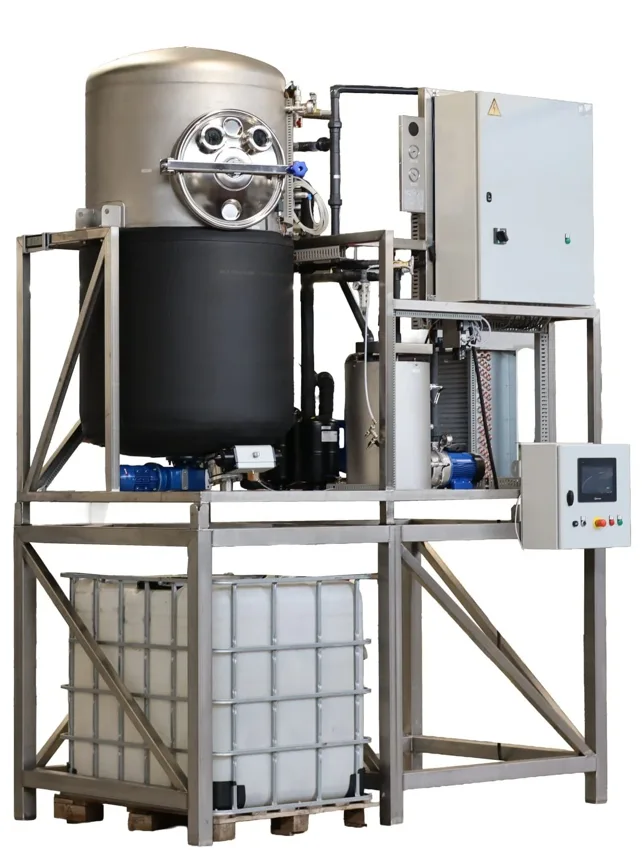
The HP series operates at reduced pressure. The heat pump provides heat for evaporation and cooling for condensation. This produces two separate streams: water distillate and concentrated residue.
Immersed heating exchanger. For suitable oil emulsions and liquids from degreasing and die casting that do not cause significant deposit build-up.
Manufacturer programme: 10–500 l/hAn evaporation chamber with an internal scraper helps maintain heat transfer when the residue is thickening. Suitable for water-based liquids with paints, printing inks or salts.
Manufacturer programme: 10–250 l/h| Data | HP-S 10 Opentop | HP-R 10 Opentop |
|---|---|---|
| Catalogue capacity | 240 l/day | 240 l/day |
| Installed power | 4 kW | 5 kW |
| Power consumption according to the catalogue | 1.5 kW | 2.2 kW |
| Design | Immersed heating exchanger | Internal scraper |
Data from the HP catalogue, pp. 2–3. Actual capacity and consumption depend on the liquid composition, the desired concentration and operating conditions. The photo shows the HP-R family, not necessarily the model compared.
During treatment of a suitable emulsion, water is removed, while oils and other less volatile components remain in the concentrate. This in itself does not mean obtaining clean oil for reuse. The required water quality and any additional treatment are determined according to its subsequent use.
SMALL QUANTITIES / CONCENTRATION
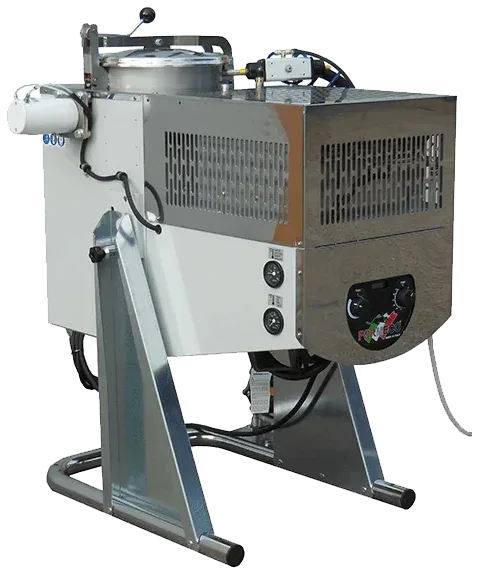
Concentrators with heating through a thermal oil jacket are of interest for smaller quantities and a higher required concentration of the residue. Static versions Ci and scraper versions CiQ are available.
Data from the concentrators catalogue, p. 3. The selection of equipment for aqueous liquids is checked separately; the Ci designation does not mean the same design as the Di solvent still.
Concentrators from the manufacturer ↗Forced circulation of the liquid through the evaporation unit for larger daily quantities. Multi-stage versions are also available; for further concentration, the system can be supplemented with a suitable second unit.
HP-Cf programme ↗External heat source: hot water for HW or steam for HS. It makes sense to check this when such a source is already available in production. Versions with scraper and forced circulation are available.
External heat source ↗Mechanical vapour recompression. The compressor raises the energy level of the generated vapour, which is reused as a heat source in the evaporation process.
Vapour recompression ↗MANUFACTURER DOCUMENTATION
Five documents covering static and dynamic distillers, industrial versions and both water technologies. The catalogue can be opened or saved to your computer.
Static solvent stills. Data for Di 30 Ax LCD.
Dynamic versions for suitable liquids and residues.
Larger charges, process control and automation options.
HP-S, HP-R and HP-Cf for aqueous process liquids.
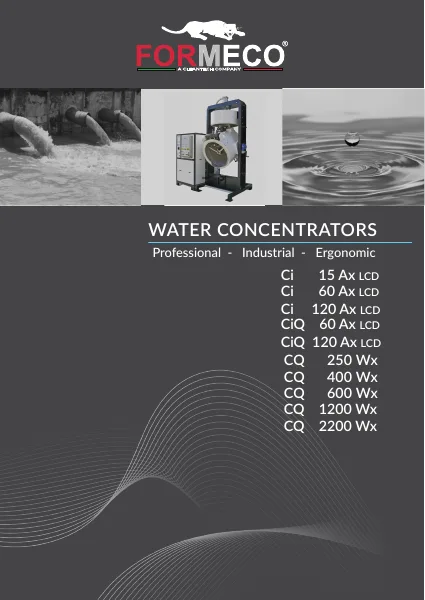
Static and dynamic versions for aqueous liquids.
FORMECO IN PRACTICE
Selected clips from the official FORMECO channel. Each shows a specific machine or application; the equipment shown is not automatically part of every version.
Presentation of a specific industrial version of a solvent regeneration machine.
Official presentation of the evaporator with heat pump and forced circulation.
Example of a special application of a concentrator. Suitability for other liquids is checked separately.
FROM LIQUID TO SUITABLE EQUIPMENT
Which process it comes from, how much is generated and what it contains. Safety data sheets for the materials used and any available analysis help.
Together with FORMECO we coordinate the need for a laboratory or pilot test and the target for the distillate and concentrate.
Capacity, heat source, cooling, machine materials, automation and residue handling follow the verified process.
“Aqueous process liquids” describes water-based liquids that arise or are used in production. When used up or contaminated, manufacturers often treat them as industrial wastewater. This may include washing waters and oil emulsions. Their treatment is determined by composition and by the way they are generated and used further.
Suitability is assessed according to the required quality for the next process. Some components may also pass into the distillate, so the result is checked by test or analysis. Reuse, additional treatment and handling of the residue are determined for the specific liquid.
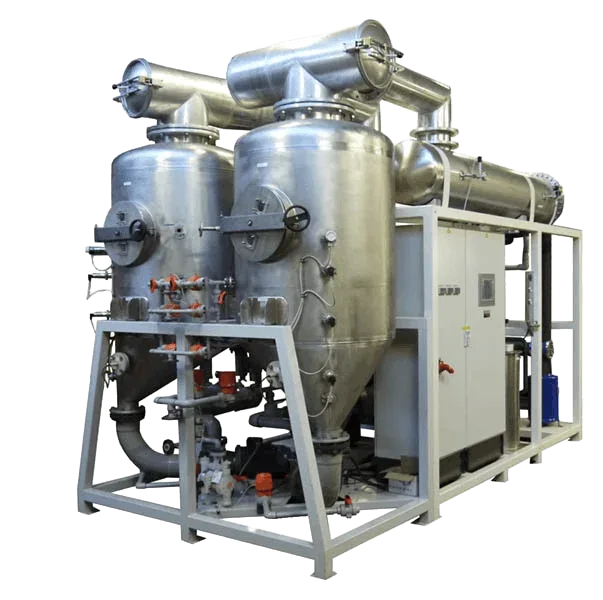
For separating liquids according to different volatility, FORMECO also offers fractionating columns. This is a special field, which we assess based on the composition of the mixture and the required separation.
Fractional distillation ↗ENQUIRY FOR YOUR LIQUID
Write which process the liquid comes from and approximately how much is generated. Together we will define the next step.