
POLYURETHANE / MATERIALS, MACHINES AND TECHNOLOGIES

Material.
Technology.
Your product.

Polyurethane machines, PU formulations and process data. Discover the connection between materials from Pozzi Industries Group, SAIP equipment and ENLIVE digital solutions.

Chemistry, machines and digital solutions.
Competences of the Pozzi Industries Group.

An example of the use of flexible polyurethane in furniture; visual by Pozzi-Arosio
MATERIAL OPTIONSShape. Comfort. Function.
PU part after moulding; photo by Pozzi-Arosio
From mould to product

LET'S START WITH THE APPLICATION

One material.
Different production routes.

Polyurethane is a family of materials with very different properties. We therefore start selecting equipment with the product, its geometry, requirements and planned production volume.

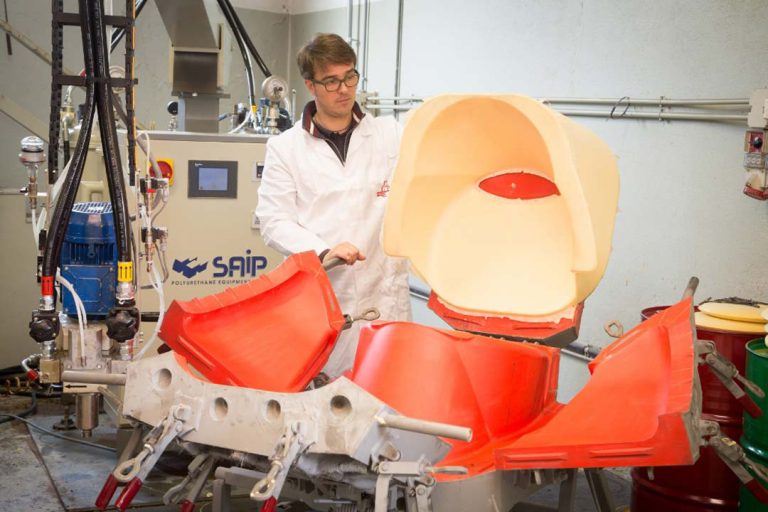
A shaped part of flexible polyurethane, removed from the mould
Pozzi-Arosio · PU moulding in mould
POZZI-AROSIO + SAIP

When the material follows the shape.

Flexible foams for seats and backs, integral foams with a compact outer skin and rigid systems for moulded furniture parts. The material composition and the mould determine the feel, density, surface and the method of further processing.

Where systems allow it, metal or other inserts are placed in the mould before pouring. The suitable dosing unit then measures and mixes the components.

Compare PU types ↓
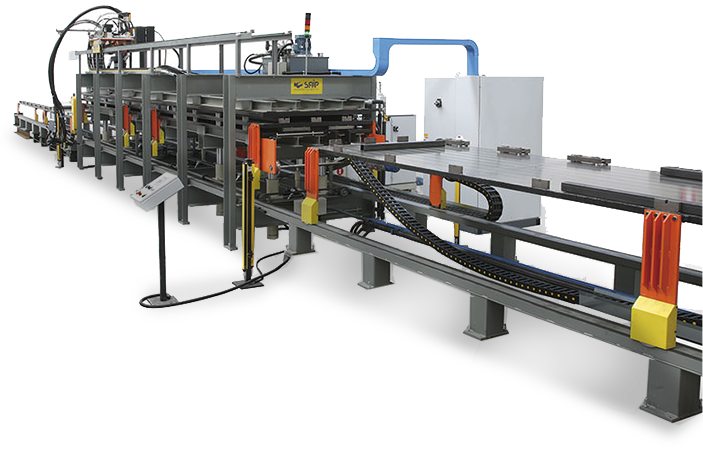
SAIP DITECH — example of discontinuous panel equipment
SAIP · DITECH implementation example
SAIP + CEDEPA + ENLIVE

Insulation core. Controlled process.

In sandwich panels, the insulation core bonds the outer facings. SAIP offers CONTITECH continuous lines for production in a continuous flow and DITECH discontinuous systems for cyclic production.

The type of facing, insulation system, panel dimensions and desired output determine the line design. CEDEPA enables development trials, while ENLIVE connects production data.

Continuous or discontinuous route? ↓
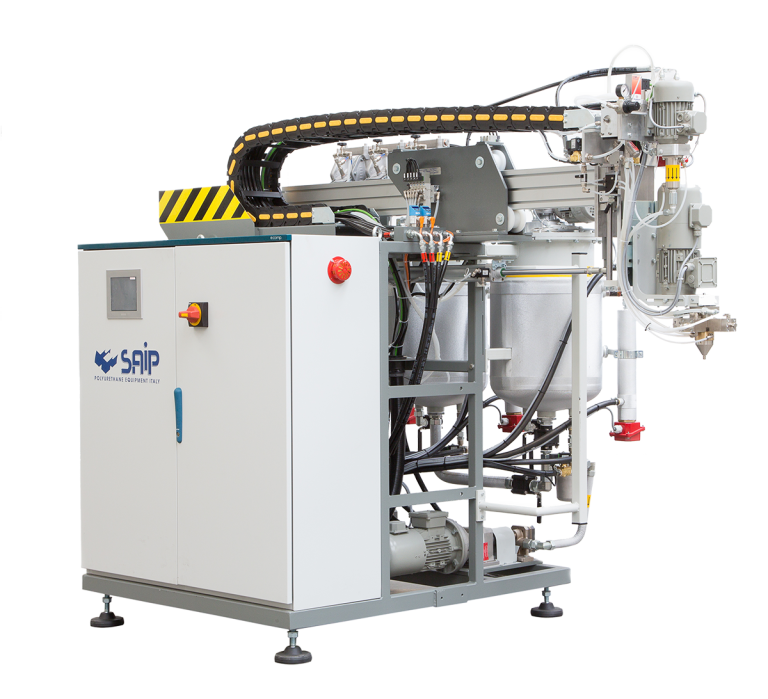
SAIP SD — dosing unit for special applications and small quantities
SAIP SD · special applications
SAIP + THE RIGHT PU SYSTEM

The right quantity in the right place.

The programme includes solutions for seals, filters and dampers, as well as separate dosing systems for elastomers. For these products, the quantity of each dose, repeatability, cycle time and material properties are important.

Another area is the insulation of cooling units, tanks and pipes. For this, the equipment is adapted to the geometry of the product and the filling method.

See selected dosing units ↓
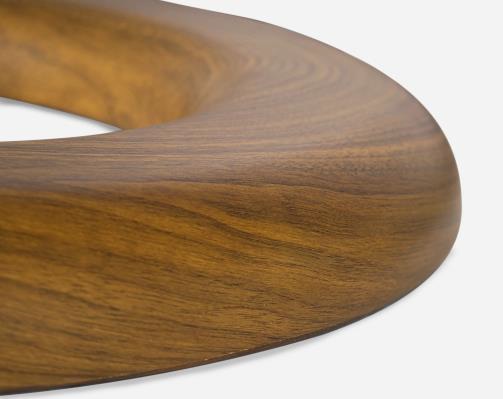
Decorated curved fence with a wood look; DipPrint example
DipPrint · decoration on a three-dimensional surface
DIPPRINT

The appearance of the surface gains a new dimension.

Water transfer decoration makes it possible to apply a pattern to suitably prepared three-dimensional objects. It is used on plastic, metal, wood and other suitable substrates.

This is a surface finishing process that can complement a product made of PU or another material. It does not replace the choice of base material and its design.

How does DipPrint work? ↓

THE CONNECTION IS KEY

Material and machine
must work together.

The product shape is not yet the complete technological process. The formulation, dosing, mixing, mould and process conditions are also important.

  1. 01

    Material

    We select the PU system according to the required product properties and the processing method.

    Pozzi-Arosio · Intertrading
  2. 02

    Dosing and mixing

    The equipment measures the components and mixes them in the ratio required by the formulation.

    SAIP
  3. 03

    Product shaping

    The process continues in a mould or on a line adapted to the specific product.

    Mould · press · production line

Schematic representation of the basic steps. The sequence and execution are adapted to the application.

Data monitor the process.

ENLIVE can connect equipment, product and production data into a single overview.

Discover Butterfly ↓

01 / CHEMISTRY AND FORMULATIONS

Pozzi-Arosio.
Properties begin in the material.

Pozzi-Arosio is a development and production specialist for formulated polyurethane systems — known in the industry as a “system house”.

Its task is to build the material for a specific application. Flexibility, density, surface appearance and processability differ between PU families, so formulations are selected together with the product requirements and processing technology.

The programme covers flexible, integral, compact and foamed rigid systems, as well as low-density foams for insulation. Applications range from furniture and moulded items to technical parts and thermal insulation.

Explore Pozzi-Arosio
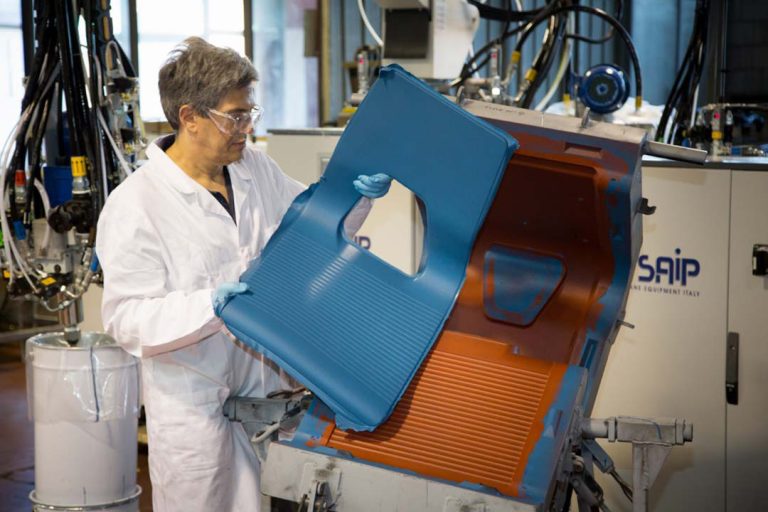
Removing a moulded integral PU part from the mould
Pozzi-Arosio · example of integral PU shaping
COMFORT AND FLEXIBILITY

Flexible PU

Cold-moulded foams for seats, backs, cushions and armrests. Complex geometry is formed in the mould.

Published density range
50–80 kg/m³
Flexible systems
COMPACT OUTER SKIN

Integral PU

A foamed part with a dense outer surface that can accurately replicate the texture of the mould and include embedded inserts.

Published density range
250–450 kg/m³
Integral systems
SHAPE AND FINISH

Compact rigid PU

Systems for moulded items, prototypes and furniture parts. For AROFLOW AF 514 GREEN PLUS, Pozzi-Arosio describes the possibility of colouring or DipPrint finishing.

Published density range
900–1.100 kg/m³
Compact systems

The ranges are the manufacturer's data for the systems or families listed. They are not universal properties of polyurethane or the technical specification of your product.

02 / DOSING, MIXING AND LINES

SAIP.
Technology for PU processing.

SAIP develops equipment from standalone dosing units to complete polyurethane processing lines.

The choice is not determined only by kilograms per minute. The dose size, component properties, number of ingredients, mixing method, mould, desired cycle and control requirements are important. High-pressure mixing and low-pressure mixing with a mechanical mixer are different technologies; suitability depends on the specific process.

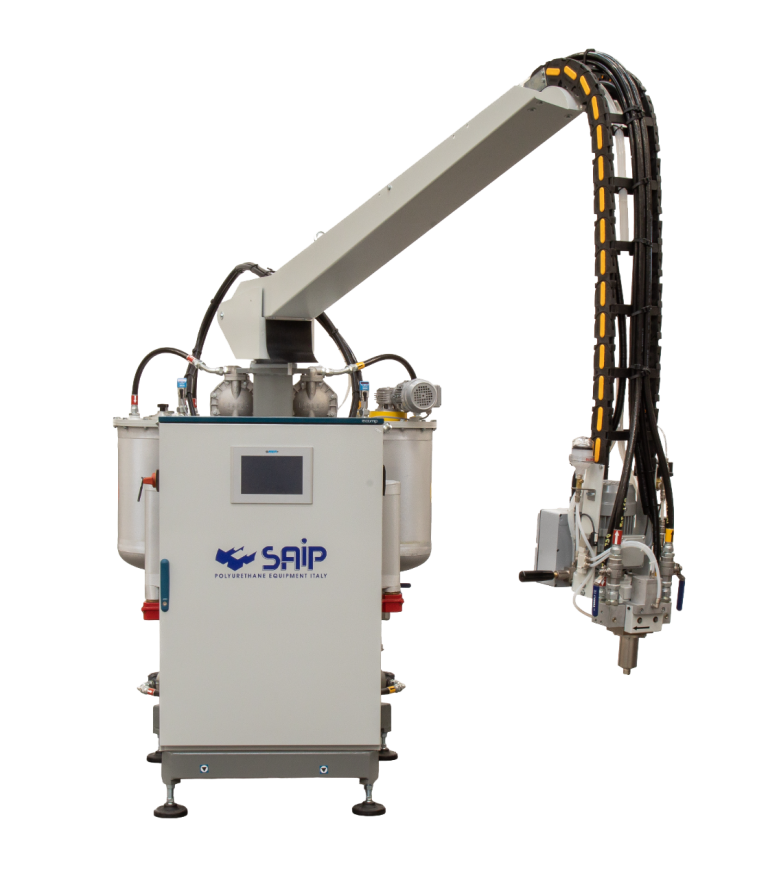
SAIP SPB — high-pressure metering unit

HIGH PRESSURE

SPB

High-pressure family for dosing and mixing polyurethane systems.

Family flow rate
10–300 kg/min
Component ratio
1 : 5 to 5 : 1
More about the version +

The manufacturer states PLC control with a touchscreen or industrial PC. The method of flow adjustment, additional components and options are determined by the unit version.

SPB technical programme
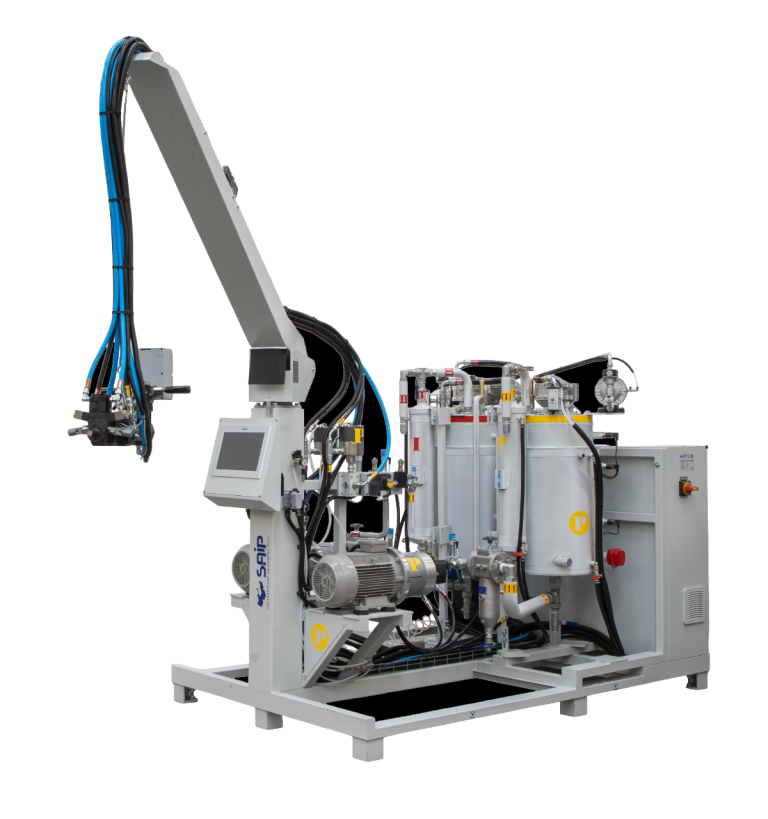
SAIP S — low-pressure metering unit

LOW PRESSURE

S

Dosing and mixing of foamed and non-foamed PU systems.

Family flow rate
7–300 kg/min
Component ratio
1 : 5 to 5 : 1
More about the version +

PLC and touchscreen allow parameter setting and display. The manufacturer states component flow control with frequency converters. Conditioning and cleaning equipment is selected according to the version.

S technical programme
SAIP SD — low-pressure unit for special applications

SMALL DOSES

SD

Special applications where small quantity and dosing accuracy are important.

Applications
Seals, filters, dampers
Technology
Low-pressure mixing
More about the version +

SD is intended for special processes with micro quantities of PU. The required dosing size, repeatability and cycle must be defined on the basis of your product and material.

SD technical programme

Selected machine families are shown. The flow range does not mean that every individual version reaches it. We confirm the configuration and performance for your material and application.

EL / ELASTOTECH

Special programme for elastomers.

SAIP EL is intended for metering and mixing elastomers based on MDI prepolymers. This programme is separate from the general selection of foaming equipment.

See elastomer dosing ▶

INSULATED PANELS

Two routes to panel production.

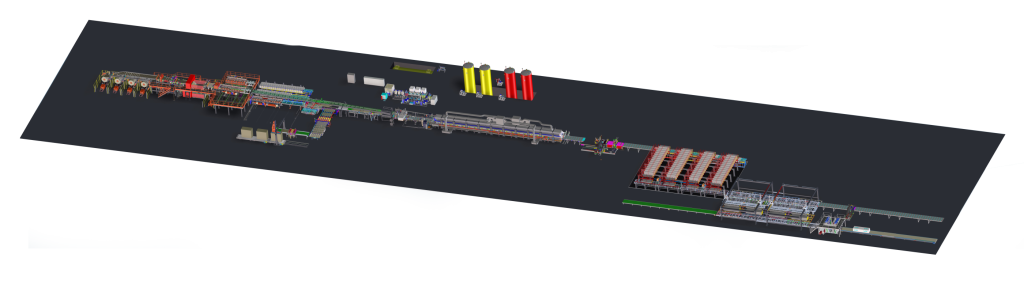
SAIP CONTITECH — illustration of the composition of a continuous line

CONTITECH

CONTINUOUS PRODUCTION

Panel production in a continuous flow: facing preparation, dosing, core forming in a continuous press, then cutting and further handling of the panels.

The programme includes configurations for PUR/PIR and also for mineral wool. Mineral wool requires suitably adapted line sections; it is not the same material or the same foaming process.

SAIP DITECH — example of equipment for discontinuous panel production

DITECH

DISCONTINUOUS PRODUCTION

Panel production in individual cycles. The solution is attractive for smaller series or a varied programme where flexibility is important.

The press, dosing unit and product handling are adapted to the dimensions, facings, insulation system and production requirements.

03 / AUTOMATION AND SOFTWARE

ENLIVE.
When data becomes useful.

ENLIVE connects industrial automation and digital production monitoring. Its programme includes PLC control systems, HMI/SCADA user interfaces and machine vision.

Butterfly is a modular platform for process digitalisation. Together with SAIP it has been developed and tested also on continuous sandwich panel lines. The aim is to connect data from the actual process with the information needed by the operator, technologist and maintenance team.

MONITORING

What is happening on the line?

Capturing process parameters and reviewing them together helps identify deviations and find the source of the problem.

Illustration of data linking. This is not a screenshot of the Butterfly user interface.

The selection of modules, sensors, data connections and integrations is defined for the specific line. The software supports the team’s work; it does not replace process preparation, training or maintenance.

04 / DEVELOPMENT AND TESTING

CEDEPA.
Validation before the production decision.

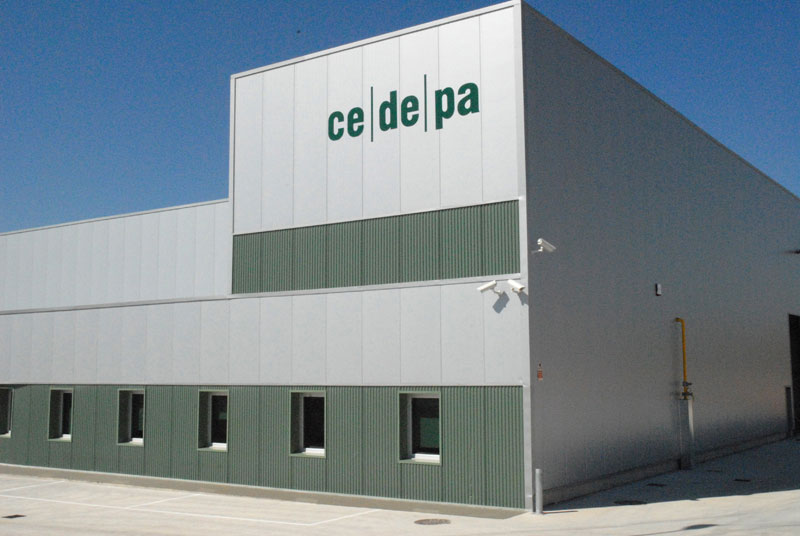
CEDEPA development centre in Tudela, Spain
CEDEPA · development centre for insulated panels

CEDEPA combines an industrial test line and a laboratory for the development of insulated panels.

The centre in Tudela, Spain, enables testing of materials, facings and process solutions on an industrial scale. Development series can be carried out without interfering with the customer’s regular production.

The programme includes product development, laboratory testing, preparation for certification and line training. The project objectives, materials, scope of testing and success criteria are defined in advance.

Development requirementTestEvaluation
Testing services and options

05 / RAW MATERIALS AND SYSTEMS

Intertrading.
The material base of production.

Intertrading covers the supply of chemical raw materials, PU systems and technical advice in material selection.

The raw materials programme includes polyols, isocyanates, prepolymers, silicone additives and catalysts. The systems offer includes, among others, rigid, integral, flexible and viscoelastic foams as well as binders for agglomerates.

This is the field of chemistry and material supply. When planning a project, the selected system must be matched with the dosing equipment, product properties and production process. Current technical and safety data sheets are obtained for the specific material.

Raw materials programme   Systems programme
FROM RAW MATERIAL TO FORMULATION
PolyolsIsocyanatesAdditives
PU system for your application

Material properties determine the product requirements and the selected process.

06 / DECORATION OF THREE-DIMENSIONAL SURFACES

DipPrint.
A surface that follows the shape.

DipPrint — wood decoration on a curved object
DipPrint decoration example · wood look on a shaped object

DipPrint is a decoration field within Pozzi-Arosio. Using water-transfer of the pattern, it enables finishing of three-dimensional surfaces.

The pattern is transferred from a special film onto the prepared item. Applications include suitable plastic, metal and wood substrates, as well as other materials for which the process is approved.

The solution combines decoration, process and dedicated equipment. For the product, substrate preparation, adhesion, geometry and the requirements for the final surface are checked. The manufacturer's video below shows the actual process.

Discover DipPrint   See the process ▶

SEE IN PRODUCTION

Real processes.
Manufacturer videos.

The selected videos show different SAIP technologies. The presentations are examples of implementations, not the equipment specification for your project.

CONTITECH · sandwich panel manufacturing

Continuous production of polyurethane panels with rigid facings.

Insulating refrigerating cabinets

An example of dedicated equipment for foaming the insulation of refrigerating cabinets.

Metering elastomers

SAIP equipment for metering and mixing elastomer systems.

DipPrint · surface decoration

A demonstration of the technology for decorating three-dimensional objects.

The YouTube player is loaded only after your selection in the viewing window.

ADDITIONAL TECHNOLOGICAL OPTION

REPUR. The value of suitable PU residues.

With the REPUR family, SAIP is developing mechanical recycling and reuse of suitable polyurethane residues, for example from cutting and milling panels. The REPUR LT extension also addresses low-density products.

The possibility of reuse depends on the type and cleanliness of the residue and on the requirements of the new product. The share of recyclate and the achievable properties are verified by tests.

More about the development of REPUR

LET'S START WITH YOUR PRODUCT

What do you want to produce?

Describe the product, material or desired properties and the approximate production volume. On this basis we check which part of the programme makes sense for your project.

Send enquiry
Technical resources and manufacturer materials +

The presentation is based on the official websites of the companies listed. The photographs and videos are from their presentation materials. Details are confirmed with the current documentation for the selected version.

Pozzi Industries Group Pozzi-Arosio SAIP ENLIVE Automation CEDEPA DipPrint Intertrading SAIP and ENLIVE · Butterfly development Pozzi-Arosio · rigid foamed systems Pozzi-Arosio · low-density insulation foams